
The intellectuals' betrayal...
Peeking behind the power of Viktor Orbán
“Hungarian society will not give up its relative prosperity for the sake of any revolutionary fervor. In 1989 everyone made peace with one another, no one even got slapped, and the same is to happen now. As long as there is food, drink, and women, everything will go on as before. Hungarians are not starving like Romanians did in 1989. Hungary is fat, wealthy, and its economy is booming. Those who possess material wealth and power — the middle class and the upper strata — are doing fine, and they do not want any upheaval. If necessary, even if reluctantly, they may even make smaller sacrifices,” said Gábor Vida, a Hungarian national living in Transylvania, Romania in an interview. Is he right? I don’t know. But as Hungary is getting closer to the 2026 elections where a huge fraction of those eligible to vote hope to remove Viktor Orbán from his long-lasting power, a lot of my own thoughts are reflected in his thoughts.
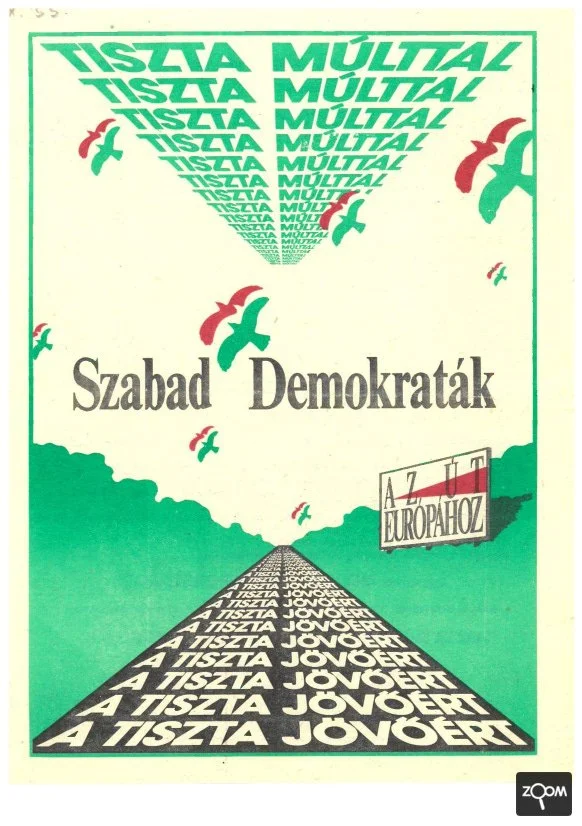
Flyer of the party Free Democrats’ Alliance (SZDSZ) in 1990, when the first elections were held after the fall of state socialism
After the collapse of state socialism, in the year of the first free elections of Hungary I was twelve years old. The regime change caught me in the lukewarm provincialism of a small town in eastern Hungary. Even there, the promise of freedom — a promise I now know was false — made the air feel almost tangible. Tricolor doves, the symbol of the party Free Democrats’ Alliance (Szabad Demokraták Szövetsége, SZDSZ) printed on little white slips of paper were scattered about on the streets. My classmates who were raised in more politically active families spent their afternoons stuffing them into mailboxes. Only those with the most amount of freedom ended up on the dusty, potholed, cracked asphalt. Occasionally the blue capital letters scribbled on the emblematic orange circle, the symbol of Fidesz at the time, appeared as well.
Thank you for reading my posts. If you want to grasp more on what is going on in Hungary, please consider subscribing and thus helping me continue my work.
I was more drawn to the tricolor doves. It was mostly the graphic design and the air heavy with the promise of freedom I liked. Funny, because it had been only a year previously that I had recited a poem to Károly Grósz himself, the last Secretary General of the Communist Party of Hungary. We performed together with the very boy who was most active in stuffing the doves into mailboxes. It was the year our hometown was granted city status.
The doves, as it appeared later, were not free enough and willingly entered into servitude with the successor of the former communist party. This eventually led to their complete annihilation. The once graffiti-like blue letters have also faded to white printed capitals. One thing, however, has not changed: Hungarians are still endlessly waiting for the regime to change. I sometimes wonder if today’s twelve-year-olds —living in what many describe as a political moment echoing that of 1990 — also feel the almost suffocating weight of the false promise of freedom. It seems unlikely when public humiliation disguised as an interview in the Partizán studio is applauded everywhere in the social media in the name of common sense.
I am not particularly drawn to the two politicians that were humiliated for announcing a new political formation. I do understand that Viktor Orbán’s power can only be dismantled by a political force matching his own. The system that we live in, however, is us. All of us, and especially the so-called intellectual ‘elite’:
The newly appointed editor-in-chief of the so-called progressive newspaper who terminates the contract of a mother with small children by saying, ‘it’s best if you stay at home and fulfil your caregiving duties.’ (Does it matter, after all, that the person is a woman?)
The well-connected parents who, instead of pointing out responsibility, spend their summer repainting the classroom of the state-financed school.
The physician who pockets a 300 percent pay raise while the nurse working next to him earns the same as before.
The social scientist who is happy to confront the regime in private but would under no circumstances appear in an article, or in front of a camera.
The natural scientist who silently watches the dismantling of the social sciences because his own field requires substantial state funding and he cannot possibly risk that ‘in the name of scientific freedom.’
The graduates of prestigious church schools who have supported the Orbán system for multiple election cycles in the name of ‘Christian-conservative values.’
The priests and pastors who, claiming to help the downtrodden, quietly pocket state billions and preach pharisaical platitudes in return.
The nursery-school teachers and schoolteachers who send troubled children to be ‘diagnosed’ rather than confront abusive parents.
The lawyers and judges who still tell themselves that their work makes them the consecrated servants of social justice.
Influencers calling themselves media workers and readily cater to an audience that craves emotion instead of understanding.
We are the system. All of us, together. When, instead of engaging in meaningful dialogue, we choose to accuse and publicly flog Katalin Cseh and Richárd Barabás, stating that they are only proxies of the regime, we show that we are actively part of the system built by Viktor Orbán. If we fail to see this, we should not hope for the system’s downfall.
Thank you for reading my posts. Consider to subscribe and thus help me continue my work.